Main content
- Learn about sports field paint lines
- Tennis Court Paint product line
- Basketball court paint product line
- Badminton paint products
- Paint the tennis court floor
- Paint outdoor sports fields
- Paint kova tennis court
- Tennis court painting construction
- Latest tennis court paint prices:
- Draw a basketball court
- Basketball court area
- Paint outdoor volleyball court
- Volleyball court paint
- Paint the outdoor badminton court
- paint indoor badminton court
- Construction of outdoor badminton court
- Badminton court paint
- Putdoor badminton court
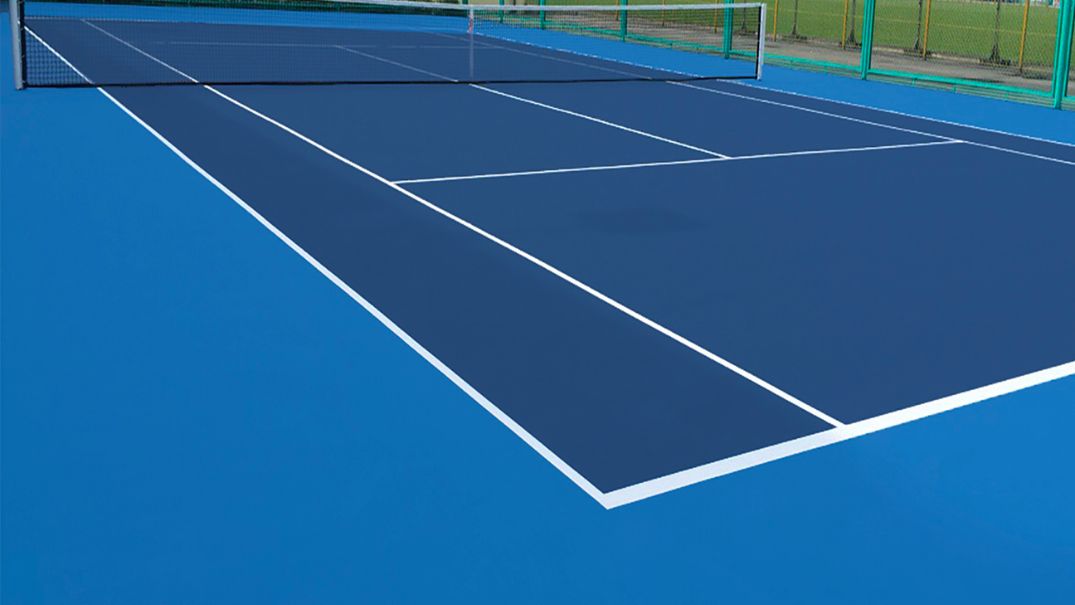
Sports fields are often built outdoors and are subject to many impacts from weather and people, so a specialized paint layer is needed to protect the field surface well. Sports field paint is a line of paint that possesses many special features, and is a construction solution to protect the sports field surface.
Learn about sports field paint lines

Learn about sports field paint lines
When painting a sports field, there are many requirements that need to be met during construction. In particular, these requirements must be mastered. Otherwise, high efficiency cannot be achieved if the process is not followed correctly. Not only that, the choice of paint is also one of the factors that determine the longevity and aesthetics of the painted surface.
The surface of sports fields often requires high construction technology and has unique features of professional sports coatings:
- The composition is acrylic and silicone as a coating on the surface of the sports field, with light gloss, high durability and good performance.
- Good toughness and good elasticity.
- The coating is suitable for harsh climatic conditions in Vietnam.
- Sustainable in acid, alkaline environments, sunlight and water.
- Paint is used to cover surfaces of concrete, wood, metal, asphalt, sports fields, sports tracks, etc.
Advantages of painting sports fields
- The use of professional sports field covering materials in sports field construction is a step forward that not only helps improve athletes' performance but also helps reduce injuries to athletes. It meets high technical requirements and provides comfort for athletes or practitioners.
- Effective dirt resistance keeps the floor clean.
- Convenient because cleaning is easy and simple.
- Create ridges so that all force moves to avoid collisions and peeling of the floor.
- Has high adhesion and good anti-slip ability, providing safety when participating in sports activities.
- There are many colors for your needs and preferences because the paint will not fade easily.
Types of sports field paint
Terraco paint:
The paint has many standard physical and mechanical features such as: gloss, anti-slip, waterproof, anti-moss, easy-to-clean surface, impact resistant, flexible, durable, and non-fading.
- Structural paint with Flexipave coating is used for tennis courts, badminton courts, and basketball courts (anti-slip surface).
- Flexipave coating provides a glossy finish to tennis, basketball and badminton courts (smooth appearance).
- Flexipave coating primer is a colorless primer used to paint badminton, tennis, and basketball courts.
- Flexipave road paint is resistant to tennis, badminton, basketball, borders, paths and multi-purpose courts.
Kova paint:
Paint can withstand chemicals, alkalis, acids, rain and especially the weather in Vietnam. Smooth glossy paint, meeting many functions of scratch resistance, impact resistance, and high elasticity.
- CT11A Gold is a reversible waterproofing agent for patio floors.
- TN A Gold creates flatness and durability, minimizing impact on the field surface.
- CT08 Gold tennis, badminton, basketball court according to color chart.
- CT08 Gold is painted white to mark the sports field.
Nova Sports USA Paint:
The paint meets global standards and is certified by the American Sports Builders Association (ASA), the International Tennis Federation (ITF).
- Novacoat paint has a waterproof buffer layer, cp 761 has high alkali resistance, provides outstanding durability, smoothness and even color.
- Novacoat color coating is applied to courts such as tennis, badminton or volleyball courts.
- Novasurface cushioning reduces impact and creates comfort.
- Novatex is used to draw opposing lines in white, orange or yellow.
How to paint sports fields effectively?

How to paint sports fields effectively?
- Construction work requires careful preparation, because failure to ensure preparation can affect construction progress and poor quality.
- Make sure the sports field surface is free of any impurities or chemicals because unwanted factors will cause the paint to not adhere or deform or the paint film to be not smooth.
- In particular, when mixing paint, it is necessary to ensure the correct ratio and dosage given by the manufacturer. The constructor needs to pay attention to avoid the paint from flowing or being too thick.
- Can be applied with a paint sprayer, roller or brush.
Tennis Court Paint product line

Paint the tennis court
Tennis court paint is a homogeneous mixture, adherent, non-slip, washable, resistant to abrasion and mechanical impact even in traffic areas. Protects the yard from bad weather effects, prolonging the life of the yard. To ensure the durability of the yard, you should choose paint from quality, specialized paint manufacturers as well as reputable construction contractors.
Note that when choosing tennis court paint, it must meet the following requirements:
- Waterproof, non-fading, highly durable, protects the underlying surface from weather and climatic conditions.
- Non-flammable, non-toxic, does not contain lead, mercury or other toxic substances, safe for constructors and users.
- Special colors used for tennis courts: dark blue, green, reddish brown, white.
Structure of tennis court base layers
- The basic tennis court base is composed of 3 - 4 layers, in special cases it can be up to 6 layers, not counting the existing base layer that has been poured with concrete or covered with hot asphalt carpet.
- Concrete foundation 10cm or more thick, minimum concrete grade > 25 Mpa, smooth, flat surface, not rough, designed with a reasonable slope for drainage. Avoid cutting heat expansion joints on concrete floors because this will affect the aesthetics and future sealant injection process.
- The asphalt base is 5cm to 15cm thick, fine grained, spread by machine and compacted tightly for optimal flatness and smoothness. Pay attention to handling areas that cannot be spread and rolled by machine and need to be done manually such as the edge of the court to create a stable structure, the tennis court floor has a long-term use, does not crack or reduce the value of the court.
Tennis court painting construction process
Step 1: Surface treatment

Surface treatment
The entire concrete surface of the tennis court needs to be ground rough and treated with an industrial grinding machine. To create flatness and eliminate weak concrete areas. At the same time, creating roughness helps the top layer of material adhere tightly and stably to the tennis court concrete floor. Then vacuum the entire floor surface.
Flatten and remove defects before applying paint. Treat with butadiene emulsion material with sand and cement mixture.
Step 2: Waterproof the floor
Use CT11A waterproofing agent which is a waterproofing agent synthesized from acrylonitrile and alkylsiloxane. It has the effect of preventing water from penetrating from the outside, but the surface still evaporates water easily. Avoid allowing water to seep into the floor as it will cause damage after painting.
Step 3: Apply a smooth, anti-slip coating

Apply black padding
Apply two layers of TN A Gold cushion coating to create smoothness, anti-slip and reduce vibrations for the tennis court surface when playing.
TN A Gold is a special chemical compound consisting of Polymer Elastomer and special chemicals and additives. Has a waterproofing effect, creating a soft cushion before coating with CT-08 paint
Characteristics of TN A Gold include high flexibility and elasticity with temperature. There are special spherical particles that prevent slipping during athletes' movements and increase the firm adhesion of the CT-08 paint above. It is used to flatten the court surface when painting the tennis court floor, creating a soft cushion and reducing vibrations for athletes when playing.
Step 4: Apply a second layer of coating to create high durability and elasticity
CT-08 is a special coating with light gloss, high durability, excellent toughness and elasticity. Used to cover surfaces of concrete, metal, wood, asphalt, composite materials for sports fields, athletics tracks, etc. Homogeneous plastic mixture, washable, abrasion resistant wear and reduce impact force during athletes' movements.
Step 5: Apply line marking paint

Construction of line marking paint
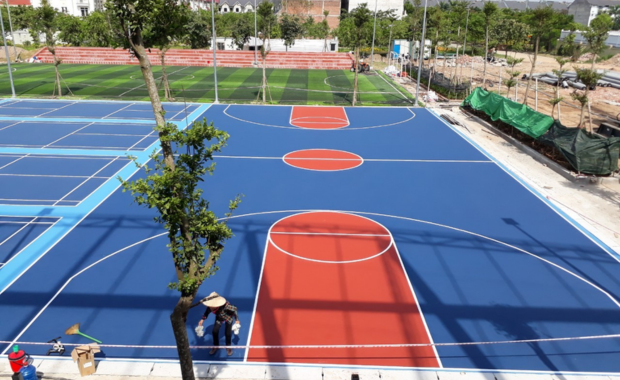
The line is the line that separates the playing area from the field surface. Therefore, drawing lines needs to be accurate, meticulous, and sharp. The tennis court surface requires that the lines on the court must be completely white. Compared to basketball, tennis court lines are simply straight lines, so construction is relatively easy.
>> See more: Measures tennis court construction effective.
Basketball court paint product line
Basketball court surface standards

Basketball court surface standards
For a basketball court surface to be considered to be of guaranteed quality, basketball court paint must meet the following factors:
- The court surface has standard hardness and is waterproof, seamless without cracks, and the paint layer is even and flat.
- The paint film can withstand the effects of a number of chemicals such as detergents, mild acids, weak alkaline environments, sunlight and erratic climate in Vietnam.
- Basketball court paint has a rough texture to avoid slipping as well as good mechanical properties such as toughness, impact resistance and especially high elasticity.
- The yard paint color needs to be uniform and able to withstand high abrasion and mechanical impact even in locations with high frequency and density of movement.
- Basketball court construction materials are fire-resistant and non-toxic to substances such as lead, mercury and other toxic substances. This is also an important factor to help ensure safety for construction workers and players.
- The painted surface of the basketball court is easy to clean and is always maintained periodically.
Basketball court painting process
Step 1: Prepare the surface
Surface treatment must be performed using specialized machinery. Normally, in this step, industrial grinding machines will be used to create a flat surface but still ensure a certain roughness so that the paint layers have good adhesion.
When doing this, you need to pay attention to rough, uneven areas. For convex positions, use an industrial grinder to make them flat. Meanwhile, for areas with pits and holes or cracks, you should use specialized materials to fill them, then grind and smooth the surface.
Step 2: Apply a layer of waterproof paint to paint the basketball court

Applying waterproof paint to paint the basketball court
The waterproofing paint layer is the first layer of paint that comes into direct contact with the concrete surface and is responsible for waterproofing the yard. During construction, be careful to ensure this paint layer is water resistant and adheres well to the surface of the yard to help protect the yard better.
For the waterproof paint to be most effective, you need to make sure it is dust-free and dry. Then, depending on the water intrusion conditions of the yard, you can paint one or two coats.
Step 3: Apply Primer Paint
This is considered an intermediate layer between the waterproofing paint and the surface paint. Their role is very important because this is an indispensable part to cover up defects and create a great surface for the yard. Therefore, when painting the basketball court in this step, you need to ensure that it meets standards.
Step 4: Apply the cushion layer

Construction of the buffer layer
The cushioning layer of the basketball court helps create elasticity for the court surface, helping players feel smooth when moving on the court. At the same time, during exercise it will also reduce the risk of falling, helping athletes avoid unwanted injuries.
At this stage, use a rubber or metal leveler to spread one to two layers of black pad evenly over the entire court surface. You choose the type of paint suitable for the sports field with the desired thickness, and can also be diluted with clean water and fine-grained quartz sand to increase friction.
Step 5: Apply the coating layer

Apply coating layer
This is the final layer of paint, in direct contact with the player, so it must have high friction. When done, it is necessary to construct carefully so that the yard achieves a certain thickness, ensuring continuity and uniformity. According to experienced experts, you should apply two layers to achieve the best conditions. In the paint, you can add fine-grained quartz sand.
Step 6: Construction of basketball court lines
This is the final step, completing a basketball court requires precision and meticulousness. To do this, measure and get an accurate score, then use paper tape to secure it. Be careful not to smear paint on the surface of the yard to ensure the yard has the highest aesthetics.
Sports field paint products with moving balls

Paint the volleyball court
Volleyball is an indoor and outdoor sport that is popular today in our country. For those who practice volleyball, a quality volleyball court will make training easier and better. One of the factors to create a good soccer field is volleyball technique.
Types of volleyball court surfaces
According to competition rules, the volleyball court must be flat, not rough or sharp. Given space and size, the court surface can be made from wood or synthetic materials.
The volleyball court needs to be 18m long and 9m wide and the areas around the court must be about 3m wide. The center line of the field divides the playing area into two equal parts, measuring 9mx9m.
Currently, there are four types of courts used for practice and competition:
The volleyball court is made of PVC carpet: This type of carpet has high physical resistance due to the friction of the ball and human feet and is good at anti-slip. The interwoven fiberglass mesh layer increases the life and stability of the foam layer. This foam layer will help reduce impacts and injuries when playing.
Volleyball courts are made of concrete: The advantage of this type of court is its high durability. However, it is not recommended to use because it can easily cause injury to players.
Volleyball court is made of PU silicone: The court uses waterproof PU silicone material that is not subject to wear and tear due to the effects of weather. At the same time, the surface is also easy to clean and has a long lifespan.
Steps to paint a volleyball court
Steps to paint a volleyball court
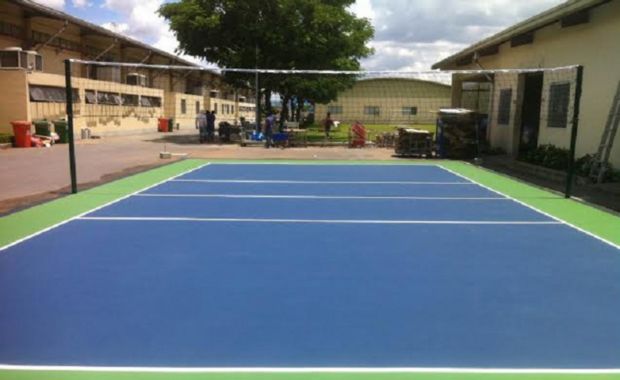
- Surface preparation: In this step, all surfaces need to be smooth, without protrusions. Therefore, you need to use a high-pressure sprayer or handheld device to remove moss and old layers of paint and lime on the surface. In the case of a newly plastered concrete surface, you need at least 17 days in sunny conditions for the surface to dry completely.
- Applying a waterproofing layer: This is a step that helps prevent the yard surface from peeling or cracking due to the influence of weather factors.
- Construction of the cushion layer: This stage is to create good adhesion for the base layer and subsequent layers of the field, while also contributing to creating elasticity to ensure competition.
- Applying the finishing coat: It is necessary to apply about two to three coats of the finishing coat, each layer should be spaced 4 to 6 hours apart. When painting the volleyball court in this step, you need to spread it evenly to ensure smoothness and flatness of the court surface.
- Line construction: This is a layer that helps create color for the field surface as well as separate the playing area and the border around the field.
Badminton paint products

Paint the badminton sports court
With simple yard regulations and playing attire, badminton is a widely popular sport in the community from fitness purposes to professional sports competing in international tournaments. We can easily see badminton courts in rural villages at rice drying yards, communal house yards, badminton courts with fixed net posts at state-owned enterprises with courts with red brick floors, concrete floors or Ceramic tiles with simple painted lines.
Even more advanced is the badminton court in the district-level gymnasium, the sports complex that organizes national and international tournaments with court surfaces made of materials: wooden floors, vinyl floors, painted floors. The yard is covered with badminton carpet. Athletes can compete in badminton under optimal conditions, in the gym under an artificial lighting system, the badminton court height is standard design, airtight, does not affect the speed of the shuttlecock.
Construction process of painting badminton sports courts

Construction process of painting badminton sports court
Step 1: Prepare the surface
- Clean the surface by machine, you can use industrial grinding machines to create a flat and rough surface for good paint adhesion.
- In rough, protruding places that are not flat, we need to use a grinder to make them flat.
- Areas with holes, punctures, or cracks should be filled with standard materials, then ground and smoothed.
- If the previous badminton court was not constructed well, or in the worst case, the whole yard is sunken or subsided, we need to use special materials and methods to overcome that situation.
- We need a flat surface with enough roughness and no dust on the surface to prepare for the painting process. If the surface is rough, it will affect the aesthetics and quality of the yard. If the surface is covered with dirt, when painted, the adhesion of the paint will not be good, and the quality of the yard will not be guaranteed.
Step 2: Apply the badminton court waterproofing layer
- The important requirement before painting is that the yard surface is dust-free and dry.
- It is the first layer of paint that comes into contact with the concrete surface and is responsible for waterproofing the yard.
- This is a special paint layer that is water resistant and sticks extremely well to the surface of the yard.
- Depending on the conditions of the yard, we can paint one or two layers.
Step 3: Apply primer layer
- The primer layer is responsible for connecting the waterproof paint layer and the yard surface paint layer.
- Primer is an indispensable part of creating a great badminton court surface.
Step 4: Apply the buffer coat
The cushion paint helps the court surface have a certain elasticity, so when athletes move on it, they will feel very smooth.
During movement, collisions will occur, at which time the cushioning layer will help the athlete avoid injury.
Step 5: Apply the coating layer
As the final coating that comes into direct contact with the athlete, it requires high friction.
Careful application is needed to achieve a certain and uniform thickness.
It is recommended to paint twice to achieve the best conditions.
Step 6: Apply the line
- Lining requires precision and meticulousness. Measure and score accurately.
- The lines to be painted must be straight and standard on the surface. Do not let paint stick.
- We carefully construct all yard surfaces step by step.
- Each process is strictly and strictly controlled. For badminton courts, safety and accuracy are top priority.
Paint the tennis court floor
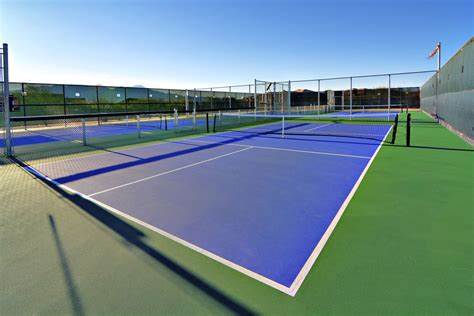
- Paint the tennis court floor is a type of paint used to create tennis court surfaces. Tennis court surfaces must meet many requirements, including adhesion, elasticity, abrasion resistance and slip resistance. Tennis court paint is often specifically designed to meet these requirements and create a good tennis playing surface.
There are many popular types of tennis court floor paint, including:
Acrylic paint
Acrylic paint is a popular choice for tennis courts. This type of paint dries quickly and has good elasticity, helping to minimize the impact of injuries when playing tennis.
Latex paint
Latex paint is also used to create tennis court surfaces. It has good elasticity and adhesion, helping to create a smooth and smooth surface.
Rubber paint
Rubber paint has high elasticity and durability, helping to withstand pressure and abrasion when playing tennis.
Polyurethane paint
Polyurethane paint is a type of paint with good adhesion and water resistance, suitable for outdoor tennis courts.
- Tennis court floor paint can be blue or red, depending on the tennis court manager's choice. Blue and red are two common colors used for tennis court surfaces.
- When painting tennis court floors, follow the manufacturer's instructions and be sure to carefully prepare the court surface before painting. This ensures that the paint will adhere well and create a high quality tennis court surface that meets tennis playing requirements.
Paint outdoor sports fields
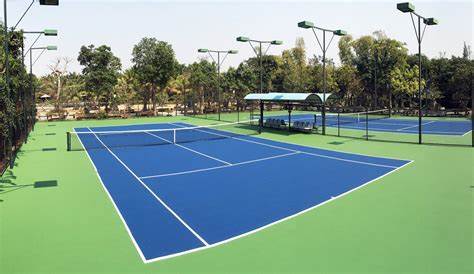
- Paint outdoor sports fields is a type of paint used to create surfaces for outdoor sports fields such as tennis courts, soccer fields, badminton courts, volleyball courts, basketball courts, golf courses, and many other types of fields. The common characteristics of outdoor sports court paints are that they are durable, resistant to the effects of weather, sunlight, rain, and reliable to withstand force and friction when playing sports.
Popular types of outdoor sports court paint include:
Outdoor acrylic paint
This is a weather-resistant acrylic paint with good elasticity and abrasion resistance, suitable for many types of outdoor sports fields.
Outdoor rubber paint
Rubber paint has high elasticity and good weather resistance, making it a popular choice for soccer fields, basketball courts, and other sports fields.
Outdoor epoxy paint
Epoxy paint is highly durable, pressure-resistant and anti-slip, often used for tennis courts and badminton courts.
Outdoor polyurethane paint
Polyurethane paint has good elasticity and abrasion resistance, suitable for golf courses and other sports fields.
When painting outdoor sports fields, surface preparation is very important. The surface must be cleaned, meet flatness requirements, and ensure good paint layers to achieve a high quality court surface.
- Choosing the appropriate paint depends on the type of yard and the specific requirements of the project. Always follow the manufacturer's instructions and safety rules when using outdoor sports field paint.
Paint kova tennis court
- Painting the Kova tennis court (also known as KovaGrip tennis court paint) is a type of paint used to cover the surface of tennis courts. This type of paint is often used to improve grip and friction between shoes and the court surface, helping to enhance movement performance and avoid slipping during tennis play.
- Kova tennis court paint is often produced with a special formula to withstand great pressure and friction from shoes and rackets when moving on the court. In addition, this type of paint also helps protect the tennis court surface from the effects of weather and time, keeping the court smooth and quality.
Tennis court painting construction
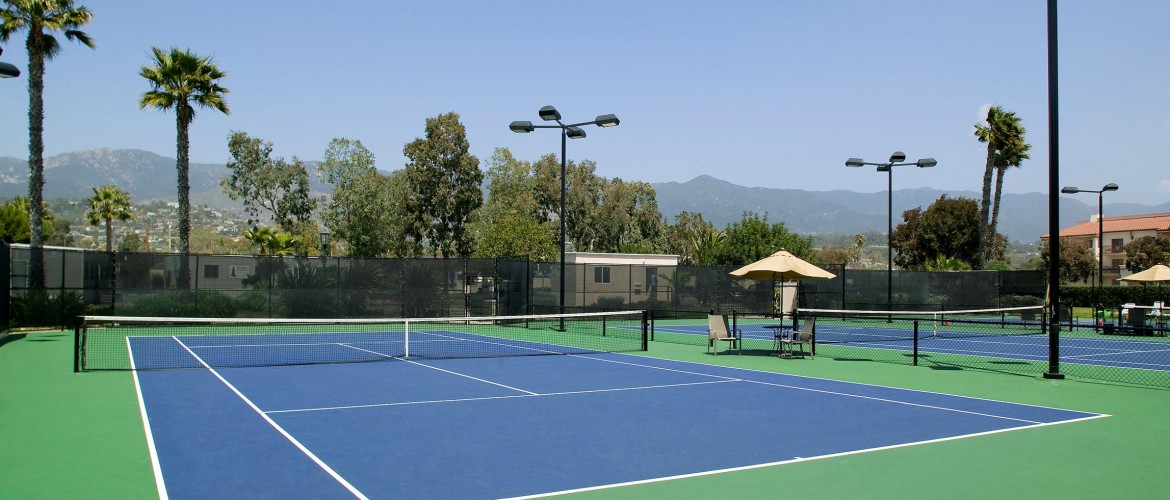
Painting tennis courts is an important process to maintain and improve court surface quality, helping to improve tennis performance and protect the court surface from natural factors such as weather and wear from regular use. Below is an overview of the tennis court painting process:
Check the status of the tennis court
Before starting construction, it is necessary to inspect the tennis court surface to determine its condition. If the yard is damaged or has cracks, steps should be taken to repair and smooth the yard surface first.
Prepare the yard surface
Before painting, the yard should be thoroughly cleaned to remove dirt, debris, wild grass and other old matter. If there are large cracks, voids, or damage, they should be addressed with appropriate repair measures.
Paint selection
Choose the type of tennis court paint suitable for the court surface and specific environment. There are many different types of tennis court paint on the market, make sure you choose paint that is of good quality and suitable for the conditions of the tennis court.
Perform painting
Paint the tennis court surface according to the paint manufacturer's instructions. Typically, tennis court painting is done using spray paint equipment or paint rolls. Make sure the color is even and cover the entire surface of the yard.
Paint coating (optional)
Some tennis court paints require a topcoat to ensure greater quality and durability. This coating is usually applied after the main paint layer has dried.
Drying time and use
To ensure best results, let the paint dry completely according to the manufacturer's instructions before allowing players to use the court again.
Maintenance and upkeep
After completing the painting of the tennis court, ensure regular maintenance and upkeep of the court. This includes cleaning the court surface, inspecting and repairing new cracks or damage, and reapplying paint as necessary to maintain the quality and performance of the tennis court.
If you do not have experience or are not confident in painting tennis courts, you should hire a professional company or contractor with experience in this field to ensure the process is carried out accurately and with quality. .
Latest tennis court paint prices:
| Product's name | Unit price | Coverage Square meters |
|
KOVA CT08 – tennis court paint, white, blue, red sports court paint. |
$38,26 – $182,34 |
Depending on the surface |
| KOVA CT08 – Tennis court paint, sports field paint. |
$43,75 – $210,01 |
Depending on the surface |
Note: the above price list is for reference only!
Draw a basketball court
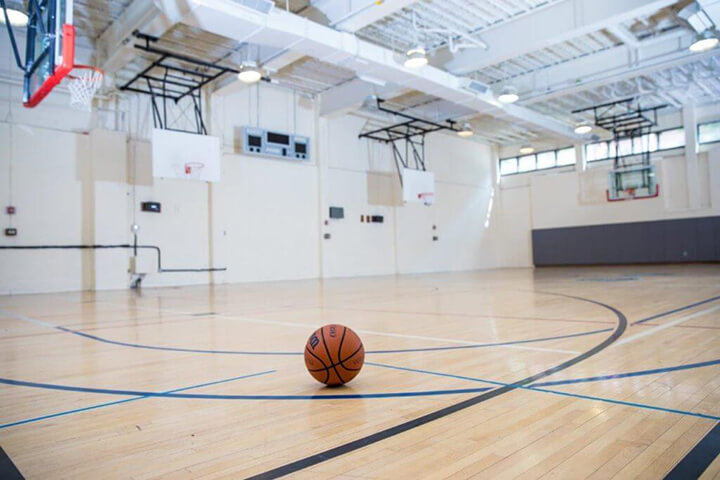
Draw a basketball court can be done for different purposes, the following are some main purposes:
Construction instructions
Draw a basketball court can be used as a blueprint to guide the process of building a new basketball court. Drawings will include exact dimensions, basketball goal positions, offensive zones, guard zones and other details needed to build a basketball court that meets standards.
Playground planning
Basketball court drawing can be used to plan and mark the location of playgrounds at sports facilities, schools, residential areas, parks, or other recreational areas. This helps organize and manage the playground effectively and arrange for convenient and safe basketball activities.
Technical appraisal
Basketball court drawings can be used to evaluate and check the technical elements of the court such as size, height of basketball columns, distance to surrounding structures, etc. This helps ensure the basketball court meets safety and technical standards.
Training and guidance
In physical education or basketball coaching, basketball court drawing can be used to instruct students or players on correct basketball positions and techniques.
Tournament planning
For basketball tournaments or sporting events, basketball court drawings can be used to plan the location of the playing fields, schedule matches, and assign teams.
Basketball court area
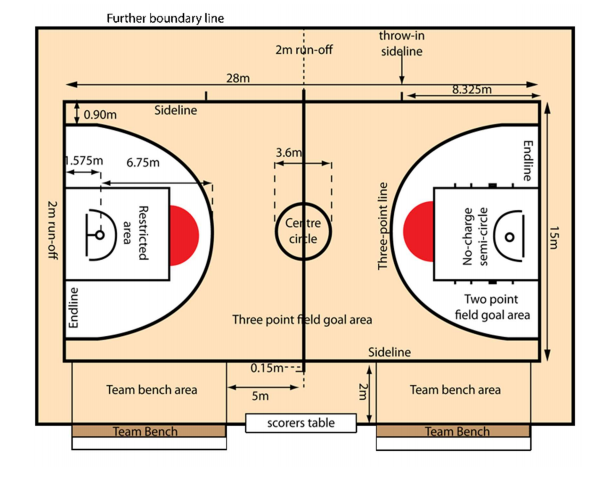
Basketball court area may vary depending on the type of course and specific definition standards. Below is the typical area of two popular types of basketball courts:
Outdoor Basketball Court:
International standard size (FIBA): 28.7m x 15.2m (94 feet x 50 feet).
Area is about 437.4 m² (4,700 square feet).
Indoor Basketball Court:
International standard size (FIBA): 28m x 15m (92 feet x 49 feet).
Area is about 420 m² (4,520 square feet).
Paint outdoor volleyball court

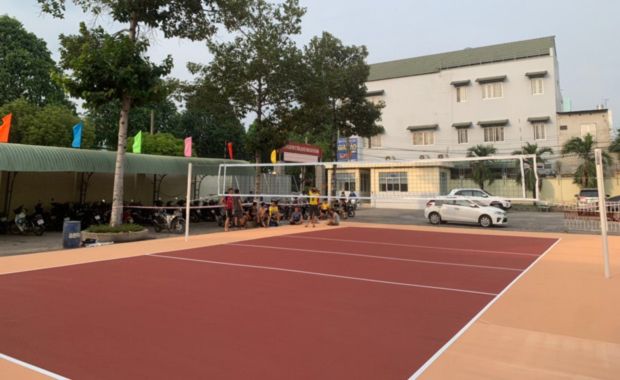
Paint the outdoor volleyball court is a type of paint used to cover the surface of outdoor volleyball courts. This type of paint is often designed to withstand harsh weather conditions, ensuring the soccer field is always durable and safe for players.
Features of outdoor volleyball court paint include:
Avoid slippery
Outdoor volleyball court paint is designed to increase grip between the court surface and playing shoes, helping to reduce the risk of slipping and injury for players.
Weather resistant
Outdoor volleyball court paint must be able to withstand sun, rain, wind and other weather factors that outdoor courts often face. This helps protect the court surface from damage and keeps it looking new.
Durable
This type of paint must be able to withstand wear and tear from soccer shoes, regular movement and sports activities on the field surface.
Color and marking
Outdoor volleyball court paint usually has appropriate colors and clear markings to clearly define the location of the courts and boundaries, making it easy to distinguish areas on the court.
Volleyball court paint
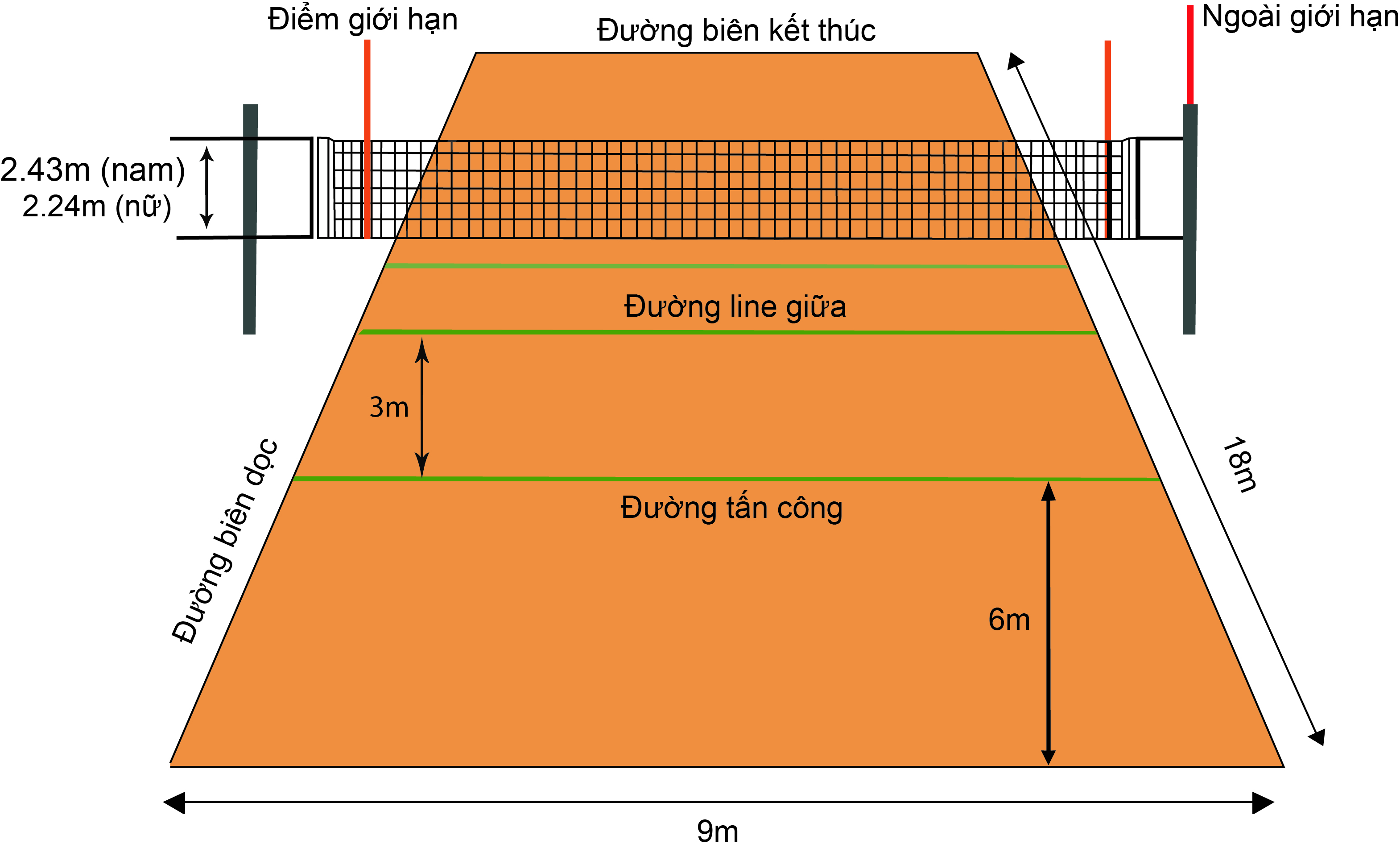
Paint the lines of the volleyball court (also known as volleyball court marking paint) is a type of paint used to draw boundary lines and markings on the surface of a volleyball court. These boundaries and markings play an important role in locating areas on the court, helping to define the dimensions and rules of the volleyball game.
Paint the outdoor badminton court
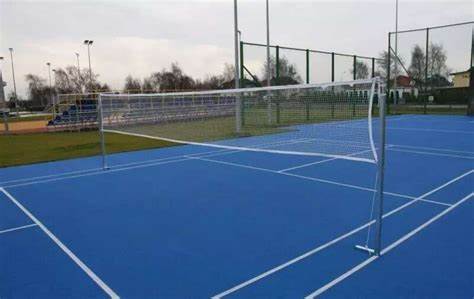
Paint the outdoor badminton court is a type of paint used to cover the surface of badminton playgrounds located outdoors. This paint is specially designed to withstand harsh weather conditions and the players' regular activities, helping to protect the court surface and enhance badminton performance.
Features of outdoor badminton court painting include:
Avoid slippery
Outdoor badminton court paint must have anti-slip properties to ensure good adhesion between badminton shoes and the court surface. This helps reduce the risk of slipping and injury for players.
Weather resistant
This type of paint needs to be able to resist sunlight, rain, and withstand sunlight and other weather factors that outdoor yards often face. This helps protect the court surface from damage and keeps it looking beautiful.
Durable
Outdoor badminton court paint must be highly durable to withstand abrasion from badminton shoes, frequent movement and sports activities on the court surface.
Color and marking
Painting an outdoor badminton court usually has suitable colors and clear markings to identify areas on the court such as the boundaries, service areas, etc.
- When choosing to paint an outdoor badminton court, you need to pay attention to the quality and features of the product, as well as follow the manufacturer's instructions to achieve the best results in painting and maintaining the badminton court. Painting outdoor badminton courts is usually done by experts or contractors with experience in this field to ensure good results and meet the technical requirements of the outdoor badminton court.
paint indoor badminton court
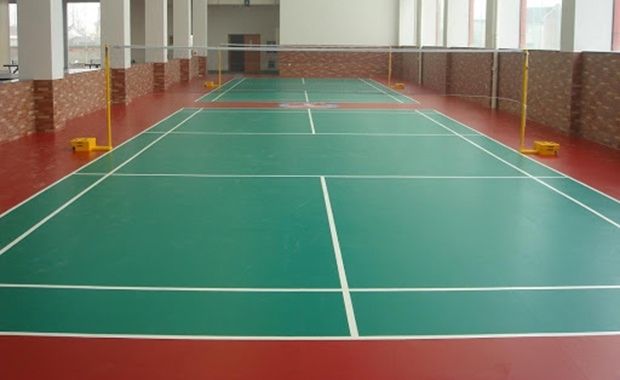
Paint the indoor badminton court is a type of paint used to cover the surface of indoor badminton playgrounds. This paint is specially designed to meet the specific requirements of playing badminton in indoor environments, where high adhesion, durability and aesthetics are required.
Features of indoor badminton court paint include:
High grip
Sơn sân cầu lông trong nhà cần có độ bám cao giữa giày cầu lông và bề mặt sân để giúp người chơi di chuyển linh hoạt, nhanh chóng và an toàn.
Durability and abrasion resistance
The indoor badminton court surface must withstand abrasion from moving, hitting the shuttlecock, and regular activities of the players. Indoor badminton court paint needs to have high anti-abrasion properties to protect the court surface from damage and keep it beautiful and durable.
Anti-slip ability
Indoor badminton court paint needs to be anti-slip to reduce the risk of slipping and injury to players in indoor environments that often have high humidity.
Color and marking
Indoor badminton court paint usually has suitable colors and clear markings to identify areas on the court such as the boundaries, service areas, etc.
Environmental friendliness
Some types of indoor badminton court paint are made from environmentally friendly materials, helping to minimize negative impacts on the environment during use and maintenance.
Construction of outdoor badminton court

Outdoor badminton court construction is the process of building and completing an outdoor badminton playground. This is a complex process and requires attention to many aspects to ensure the badminton court meets the safety, quality and performance standards for badminton play.
Below are the basic steps to construct an outdoor badminton court:
Planning and design
The first step is to plan and design the outdoor badminton court. This includes determining the size of the court, location of badminton poles, marking areas, etc. Space requirements, layout and safety regulations for badminton courts should be considered.
Surface preparation
Before proceeding with construction, the badminton court surface needs to be carefully prepared. This includes leveling and paving the court, ensuring a flat, hard and durable surface to meet badminton requirements.
Construction of badminton poles
After the surface is ready, proceed with the construction of the badminton pole. Badminton poles need to be installed firmly and ensure the correct position according to standard dimensions.
Marking paint
Next, paint and mark lines on the court surface to identify the boundaries, service areas, foul areas, etc. Marking should be done carefully and accurately to ensure the clarity and accuracy of the boundaries.
Complete
Finally, check and complete the project. Ensure the badminton court fully meets safety and quality standards before being put into use.
- The outdoor badminton court construction process needs to be carried out by experts or contractors with experience in this field to ensure good results and meet the technical requirements of the outdoor badminton court.
Badminton court paint

Paint the badminton court (also known as badminton court marking paint) is a type of paint used to draw boundaries and markings on the surface of a badminton playing field. These boundaries and markings play an important role in determining the location of areas on the court, helping to define the dimensions and rules of the badminton game.
Putdoor badminton court
Outdoor badminton court is a badminton playing area located outdoors, usually at sports areas, parks, schools or public sports facilities. The outdoor badminton court is built and designed to play badminton under extreme weather conditions and meet the needs of entertainment, fitness and community participation.
Features of outdoor badminton courts include:
Size
The standard size of an outdoor badminton court is not necessarily the same as the size of an indoor badminton court. However, common dimensions for outdoor badminton courts are usually 13.4m x 6.1m (44 feet x 20 feet) for singles matches and 13.4m x 7.0m (44 feet x 23 feet) for doubles matches. .
Surface
The surface of an outdoor badminton court is usually a hard surface, such as concrete, asphalt, steel floors, or synthetic surfaces. This hard surface helps increase grip between badminton shoes and the court, reducing slipping and ensuring player safety.
Tick
The outdoor badminton court is painted with lines to mark the boundaries, service lines, range lines and foul areas. The marking lines need to be clear and precise to ensure fairness and fun in playing badminton.
Surrounding space
Outdoor badminton courts often have spacious and comfortable surrounding spaces so that players and spectators have space to move around and watch the match conveniently.
- The outdoor badminton court is a fun place to participate in sports activities, exercise and meet friends. When building an outdoor badminton court, attention should be paid to compliance with safety standards and reasonable design to create the best sports environment for everyone.
Contact Info:
CHI HAO TRADING SERVICES COMPANY LIMITED
Address: 606/76/4, Highway 13, Hiep Binh Phuoc Ward, Thu Duc District, Ho Chi Minh City
Phone number: 028 626 757 76
Hotline: 0818 21 22 26
Fax: 028 626 757 28
Email: [email protected]